
A visiting friend stops to take in the breathtaking ocean colours of turquoise, aqua and blue as I snapped his picture.
Marta
A visiting friend stops to take in the breathtaking ocean colours of turquoise, aqua and blue as I snapped his picture.
Marta

Such a wonderful evening watching the sun go down while floating in the water. We didn't see the "green flash" because of the low clouds on the horizon.

Barry deserves top billing as he "frolics" in the water with an ever present Coors Lite!!!

We motored out from our Marina channel to a small sliver of white powdery sand beach for a few hours Sunday afternoon
It was pretty windy and the ocean was rough last Sunday but we thought it would be fine. It was a bumpy ride over the white caps so much so that I was literally gripping onto the hand rail. Luckily we were protected from the wind and things calmed down as we approached and moored at a little beach.

As I explored the island, the others stayed on the boat and slowly made ready to enjoy the water.

I was thrilled to see several Rock Iguanas and I could hear the rustling of many others as they made their escapes before I could spot them.
The Turks and Caicos Rock Iguana was re-introduced to several of the many little Cays. It is an endangered species of lizard and is endemic to the Turks and Caicos Islands.

The waves were pounding on the far side of the island and I was fascinated by the large rock formation with a hole in it.

We enjoyed the sun, sand and beach and of course we had it all to ourselves. Even the iguanas didn't mind sharing this little spot of paradise.

Papaya trees come in one of three sexual forms: male, female and hermaphrodite and the photo above is of a male flowering papaya.
The Papaya tree or Paw Paw is found growing wild throughout the Turks and Caicos Islands and we have several here at Harbour Club. Presently, Barry and I are juicing these wild papayas almost every day as we have so many that are ready to eat right now.

Male flowers are formed in clusters and grow on a branched drooping stalk
Male Papaya flowers have no ovaries and therefore do not produce any fruit. Female flowers have an ovary and are borne on the stem of the plant where the leaf is attached.

Beautiful yellow flowers of the female gender have five petals and are rather waxy looking.
Some papaya bear only short stalked female flowers while others bear male clusters of flowers and pollination is done by the wind.

The bright yellow petals start to wilt and turn brown as the fruit starts growing

A small papaya fruit appears and starts to grow
The ovary of a female Papaya plant must receive pollen from either a male or hermaphrodite plant before it can be fertilized and produce a fruit bearing viable seeds. Insects and or the wind will carry the pollen.

A small baby papaya starts to grow as the yellow petals die off.

Harbour Club's papaya trees are loaded with small fruits ready to be picked.
Papaya trees can grow from 6 to 20 feet tall and have a head of foliage much like a palm tree up at the top. The trunk is soft wooded, never developes a bark and is ringed with scars from previous leaf stems that have dropped off.

Tall papaya trees reaching to the skies laden with fruits
Wild papaya fruits aren’t really that large but they are favoured by the birds so long as Barry doesn’t get to them first. They are delicious served up as a smoothie or eaten with lots of fresh lime juice.

If you throw out these seeds they'll be sure to grow more trees.
Papain from the papaya is used by the locals and applied topically for the treatment of cuts, rashes, stings and burns. It is said that Christopher Columbus named the papaya or paw–paw, ‘the fruit of the angels’. Try some papaya with fresh lime juice for a tasty treat…….it is ripe and soft and has a sweet and delightfully vibrant orange flesh much like the consistency of a peach.
Marta

Ominous thunderclouds roll in at Bonefish Point
What an amazing sight as our friends swam back out to the boat before the storm ……… the ocean turned to a deep turquoise as the ominous thunderclouds rolled in. The sandbar and beach at Bonefish Point created a sparkling sliver of brilliant white breaking up the intensity of the brooding sky and sea. We pulled up the anchor and headed back to Harbour Club Marina.
Marta

Face off as two Anole Lizards prepare to do battle
I came out onto our deck today at Harbour Club to find some Anole Lizards sizing each other up as they prepared to defend their territory. I have never seen them quite this aggressive towards one another but I know that they are very territorial.

They were sizing each other up and would make sudden lunges for the head

One Anole had a strong hold on the other so much so that his head was almost torqued right around. The fight consisted of grabbing the opponent with the mouth and then using the legs and tail for leverage.

A number of times these two disengaged and I expected one of them to turn tail. They seemed intent on settling the territorial dispute.

Ferocious looking fellow isn't he?

This one had some colourful markings

Head on shot as this little lizard saw the camera

I'm not sure if this Anole sustained an injury but his head had reddish speckling
We find so many Anoles and Curly Tailed lizards on the grounds of Harbour Club Villas and Marina. Some are now getting quite big especially the Curly Tailed lizards. Hope you enjoyed these photos and I will look for some good ones of the Curly Tails for another post.
Marta

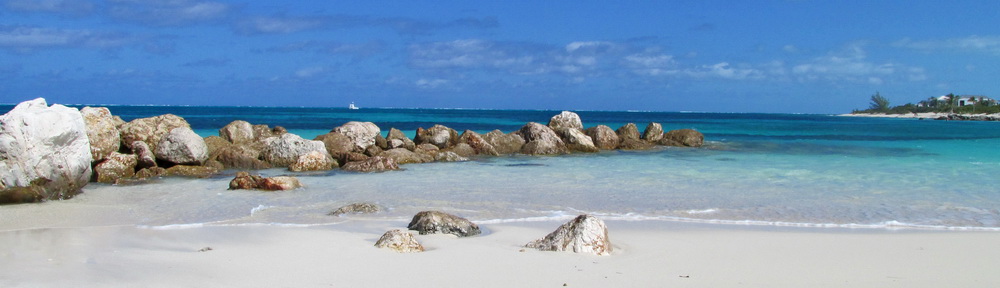
One of my favourite photos taken out at Leeward beach as the waves were splashing up over the rocks. The sky was a beautiful blue and of course the colour of the ocean was that intense turquoise found here in the Turks and Caicos Islands.
Marta

A delightful afternoon spent at a little beach close by where we took Malaika for some swimming
The water was so clear yesterday with sun reflections dancing and creating silvery patterns as we just played in the water. Malaika just loved being buoyant in the foot deep waters of the south side of Provo. She’s beginning to kick her legs and is totally unafraid of the water.

Malaika had such fun kicking her little feet and splashing in the water

Look Mom............I can touch my toes!
We took a little break and close to the shore where we were sitting in the water, we were joined by some tiny little fish. Malaika was delighted but stayed close to Mom.

Malaika spots little fish from the safety of Mom's lap. You can just make the fish out at the bottom of the photo below Mom's feet.

Here's a blow up of the little fish that were swimming around us as we sat in a few inches of water at the beach
An idyllic afternoon spent just lounging in the water close by our villas at Harbour Club. Come on down to Providenciales and enjoy our stunning beaches and the clearest water you’ll ever see.
Marta

A beautiful Jamaican Caper Tree with a mass of exotic looking blooms that turn from white to pink
I was up at a friends house and happened to notice a beautiful Caper Tree that was in full bloom. This particular tree seems to stand out when you look in the bush because it has very dense and full looking foliage with green leaves the undersides of which are a reddish brown.

The white flowers look like fireworks because of the long filaments coming from the centre of the flower
Jamaica Caper flowers have very showy, two-inch-long, purple stamens and white anthers and white petals. When the flower first opens usually at night it is white and they turn purple when the morning light hits them.

The pinkish purple flowers have numerous long deep purple stamens that burst out of the centre like fireworks

This cluster of flowers looked like pinwheel fireworks

The Caper flower has long two inch stamens that are a purple colour and the flower itself has four petals

The Caper Tree has very fragrant flowers that are loved by nectar loving birds and butterflies

Caper Trees are found growing throughout Provo and keeps all its foliage even when we have drought conditions.
Take a look as you are driving around and see if you can spot these trees. With all the flowers, they shouldn’t be too hard to find.
Marta

Judges Donna and Peggy being interviewed by WIV 4 TV.
The judges had a hard task picking winning potcakes and dogs in various competitions such as best trick, most like owner and best looking.

Anna and her potcake Kaya receiving their prizes and treats in the best trick competition

Signing up for the various events and this potcake was eager to get started

They could have left some water for a thirsty dog!

I wish they'd get the show started as these doggy face painted youngsters wait patiently

There was great excitement as everyone watched the K-9 demonstration taking down an intruder

On command, the handler ordered the dog to subdue the suspect or potential criminal.

See you all at the show next year.............Don't miss it!!
I couldn’t stay to the end of the show so missed some great events such as the obstacle course but for sure I’ll be there again next year to take in all the fun. Big thanks go out to all those hard working volunteers. If you can help the potcakes and animals here on Provo in any way, please contact the TCSPCA, Potcake Place or the Potcake Foundation. They will be glad you called.
See you in 2011,
Marta